promptly@008619121711814
Jiaxinyi Art Forges Ahead: Production Upgrades Accelerate Wrought Iron Doors Manufacturing

Nov. 10, 2023
Jiaxinyi Art Co., Ltd., a leading manufacturer of decorative metalwork, has announced a groundbreaking optimization of its wrought iron gate production line, achieving a 20% efficiency boost through advanced automation and lean management strategies.
Original production process and problem analysis
Original production process
Original process of wrought iron gate: pre-processing (raw and auxiliary material acceptance, batching, proofing), processing (cutting, production, welding, grinding, surface treatment, anti-rust treatment, painting), painting (rust removal, anti-rust paint, paint selection and spraying).
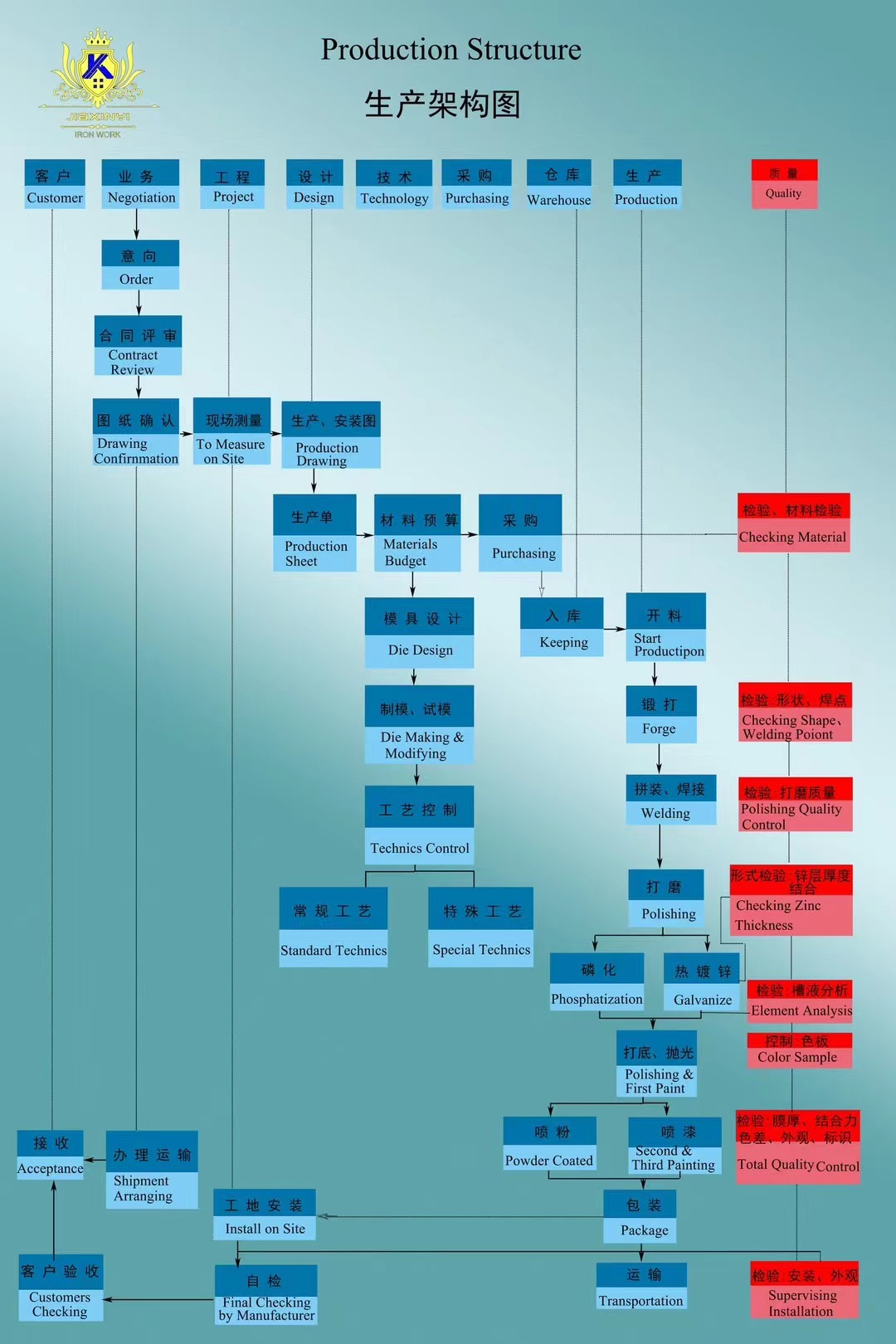
General original process: lofting (drawing, force calculation), cutting (material selection, cutting, quality inspection), bending flower assembly (forging, molding, bending, ladder flower forming, quality inspection), grinding (slag removal, polishing, quality inspection), galvanizing (rust prevention treatment), filling (filling seams), grinding (flattening), primer (increasing adhesion, drying in the paint drying room), anti-rust paint (enhancing anti-rust effect, drying in the paint drying room), topcoat (drag coating, glazing, quality inspection), molding.
Problem analysis
In terms of efficiency: the connection between each link is not tight enough, and there is waiting time, such as waiting for the grinding link after the bending flower assembly; some processes are not skilled enough, resulting in a long overall production cycle.
In terms of cost: the acceptance of raw and auxiliary materials is not detailed enough, resulting in some unqualified materials entering the production process, increasing the subsequent rework cost; the anti-rust treatment adopts traditional methods, which is costly.
In terms of quality: welding, grinding and other processes lack strict quality control standards, resulting in uneven product quality; the painting process is not standardized, and the uniformity of the paint film is difficult to guarantee.
Optimization measures
Process connection optimization
Introduce a production management system to monitor and schedule each link in real time to achieve seamless connection of each process. For example, after the bend flower assembly is completed, the system automatically notifies the grinding process to be ready to reduce waiting time.
Establish standardized operating procedures and work instructions, clarify the operating specifications and time requirements of each process, and improve the proficiency and efficiency of employees’ operations.
Cost control optimization
Strengthen the acceptance of raw and auxiliary materials, formulate more stringent acceptance standards, and conduct detailed inspections on each batch of raw materials to ensure that unqualified materials do not enter the production process.
Optimize the anti-rust treatment process and use hot-dip galvanizing instead of traditional methods. Hot-dip galvanizing can keep the product rust-free for a long time, and the anti-rust period is as long as 20-50 years or more, without maintenance during this period, reducing long-term costs.
Quality control optimization
Establish a strict quality control system and formulate detailed quality standards and inspection processes for key processes such as welding and grinding. For example, the welding process requires that the weld width and height meet the standards, and there are no problems such as false welding and leaking welding; the grinding process requires a smooth surface without burrs.
Standardize the painting process, use professional oil workers to spray paint, and fully polish and clean the products before painting to ensure the uniformity of the paint film. At the same time, strict drying treatment is carried out in the paint drying room to ensure the quality of the paint.
Optimization effect
Efficiency improvement
Through process connection optimization, the production cycle is shortened by 30%, the waiting time between each process is significantly reduced, and the overall production efficiency is greatly improved.
Cost reduction
The waste of raw and auxiliary materials is effectively controlled, and the rework cost is reduced by 40%; the optimization of the anti-rust treatment process reduces the long-term cost by 20%.
Quality improvement
The product quality has been significantly improved, the rate of unqualified products has been reduced from the original 8% to 2%, and customer satisfaction has been greatly improved.
Summary
Through the optimization of the iron art door production process, the company has achieved significant improvements in efficiency, cost and quality. This case shows that reasonable process optimization measures can effectively enhance the competitiveness of enterprises and bring good economic and social benefits to enterprises.